Showing posts with label Equality. Show all posts

Sunday, January 28, 2007

Dangerous Rhetoric

The NYT has a piece about the new strategy for Democrats. This new strategy was highlighted by the way (and who delivered) the response to the President's State of the Union. Jim Webb used his platform to cite his favorite populists, Andrew Jackson and Teddy Roosevelt. He also repeats John Edwards ridiculous claim of two Americas with the following:
"When one looks at the health of our economy, it's almost as if we are living in two different countries. Some say that things have never been better. The stock market is at an all-time high, and so are corporate profits. But these benefits are not being fairly shared. When I graduated from college, the average corporate CEO made 20 times what the average worker did; today, it's nearly 400 times."

While I agree that not all CEOs deserve the pay they get. However, who are we to judge other people. The people who lose when CEOs have big pay days are stockholders. Why should we care if stockholders lose? We should not be fooled by populists who think poor people would be paid more if CEOs were paid less. Next, Mr. Webb cites inequality:
"Wages and salaries for our workers are at all-time lows as a percentage of national wealth, even though the productivity of American workers is the highest in the world. Medical costs have skyrocketed. College tuition rates are off the charts. Our manufacturing base is being dismantled and sent overseas. Good American jobs are being sent along with them."

Here, Mr. Webb uses the old labor economist's argument of stagnating wages. But even the NYT cites that real average hourly pay rose by 1.6%, one of the highest increases in the past 30+ years. But, the problem with using stagnating wages as a measure of the American worker's prosperity is that is incomplete. Over the past thirty years, prices of goods have fallen considerably. For example, a worker at an assembly plant can easily afford a flat screen TV and a new bicycle at Wal-mart. This was not the case thirty years ago. Also, the wealth of lower class workers has also increased dramatically due to two recent phenomenon: the appreciation of homes and the record amount of the American public owning their own home (70% in 2004). Next, Mr. Webb shows his ignorance:
"Our white-collar professionals are beginning to understand it, as their jobs start disappearing also. And they expect, rightly, that in this age of globalization, their government has a duty to insist that their concerns be dealt with fairly in the international marketplace."

Jobs are disappearing. That is funny. Actually, employers can't find enough people to work for them. We are almost at full employment. The 4.5% unemployment rate is almost as low as it was in 2000, which was the lowest rate of unemployment since 1969. As for globalization, the only way that the American people would be hurt by it is if the government tries to shield the American people from it. We should all take note. The Democrats want to retreat from globalization while the Republicans (at least most of them) want to embrace it.

The next time you think of voting Democrat just think about what one of their icons says in the NYT:
“In the past, the attitude was, ‘Get government out of the way.’ And now it’s, ‘Gee, I may need it.’ ”
Lord save us if they keep this rhetoric up.

Saturday, January 27, 2007

Minimum Wage Debate

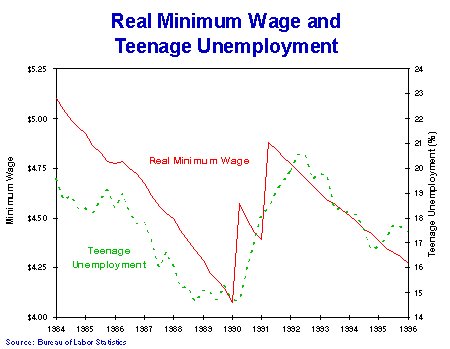
Graphical evidence of my argument from my January 29th Eagle column:


As you can see, there seems to be a correlation between the real value of the minimum wage and the unemployment rate for teenagers. This proves two points. First, the minimum wage affects mostly teenagers. And second, as the minimum wage rises, unemployment will rise along with it.

While this increase in unemployment should not be seen in the total unemployment rate, it should be interesting to watch the unemployment rate for teenagers over the next couple of years.

Friday, July 14, 2006

Krugman is an economist?

Paul Krugman does it again. He knocks the "greatest story never told" regarding the amazing US economy. In today's column he starts with the following, belittling mock conversation:

Bush supporter: ''Why doesn't President Bush get credit for a great economy? I blame liberal media bias.''
Informed economist: ''But it's not a great economy for most Americans. Many families are actually losing ground, and only a very few affluent people are doing really well.''
Bush supporter: ''Why doesn't President Bush get credit for a great economy? I blame liberal media bias.''

This is a typical problem for liberal economists to swallow. When those at the top are doing well, when companies are doing even better, the public benefits, how? Companies don't lay off people, companies HIRE more people, and companies can give raises and bonues. This is in stark contrast to what happens during a recession (and can be much worse in a prolonged recession).

Krugman is convinced that the bottom 99% are not benefiting and views inequality as rising. I agree that inequality is rising but how. Well, the rich are getting richer and the poor are getting richer (but not on the same scale as rich people). This is good. I highly doubt poor people should get raises to the level that rich people do. Does the secretary deserve a raise as big as a CEO does? No, because the CEO provides more of a benefit to more people, making them all richer. The secretary can't say the same thing.

Krugman ends with:
Can anything be done to spread the benefits of a growing economy more widely? Of
course. A good start would be to increase the minimum wage, which in real terms
is at its lowest level in half a century.

A minimum wage? Wow, an economist supporting a minimum wage. First of all, that limits economic freedom. If I want to offer my services for $3 an hour that is my perrogative. Second, it increases unemployment. Some people don't have skills that merit a company paying $7 an hour. Therefore, that company will simply not hire them ($5 is better than $0). There is evidence for this. Simply look at the America's declining unemployment rate. At the same time as this decline, the REAL minimum wage has declined as well (the nominal wage has remained steady). This translates to less wage controls = less unemployment.

Monday, June 12, 2006

What type of equality?

Equality means nothing if a country is full of poor people. As Milton Friedman said, "A society that puts equality - in the sense of equality of outcome - before freedom will wind up with neither."

Friday, June 09, 2006

Walmart is better than Welfare

Walmart has been the best thing to happen to low-income families since, well, sliced bread. They provide products at low, low prices that these families would normally not be able to buy or lose a good chunk of their pay check to. How liberals have turned Walmart into an idea that is worse than Satan-Worship I will never know.

Now, Walmart has done it again. They are providing tasty, healthier food to our country's low-income families (yours truly included) at low, low prices. They are doing this by introducing organic food at its stores. The WSJ has a great piece regarding this development. In the piece, Ms. Ward describes how the 'original' ogranic movement is upset that people don't have to spend $10 for a piece of organic lettuce at Whole Foods anymore. They disguise their argument by saying that the organic movement has sold out to big corporations. However, they should rejoice. People are demanding it and therefore big business is responding. If these liberal elites want everyone to live healthy lifestyles then they should support the only portion of society that can deliver organic food to rich and poor alike, big business. Wal-mart's CEO put it best with the following quote that closes Ms. Ward's piece...
"We don't think you should have to have a lot of money to feed your family
organic foods," Wal-Mart's CEO has said. To some, this sounds like a
threat--especially to the ethical eating elites who will have to find new ways
of distinguishing themselves from the hoi polloi--but for most of us it sounds
like good news about better food.

Thursday, June 01, 2006

A case study on how welfare fails

Welfare was near and dear to my heart. By being somebody with a big heart, I used to let my heart crowd out my brain. Therefore, I saw welfare as a way to help those that are less fortunate. However, after re-learning economics and studying the virtues of liberty and freedom, I realize that my faith was misplaced. It is with charity that we help the less fortunate. With welfare, we promote inefficiency and laziness and impede growth and creativity.

The Economist has a great article showing why Puerto Rico has failed to grow. Up until 1970, PR was growing at the same pace and vigor as the Asian Tigers. However, things started to deteriorate as welfare payments continued to invade the island from the do-good mainland Americans. The Economist describes PR's economy...

Puerto Rico's annual income per person was around $12,000 in 2004, less than half that of Mississippi, the poorest state. More than 48% of the island's people live below the federally defined poverty line. That poverty rate is nearly four times the national average, and more than twice as high as in poor states such as Kentucky, Louisiana, Mississippi and West Virginia

.


Half the working-age men in Puerto Rico do not work. Officially, only 46% of those who are not pursuing a degree have formal jobs, compared with a United States average of 76%.
The Economist goes on to state the culprits...

Many things have gone wrong. Most important, however, is that the United States government assumed too big a role in the Puerto Rican economy, and its largesse enabled the commonwealth's government to do the same. Through hubris, clumsiness and sheer size, these governments knocked Puerto Rico off the promising path that it was following, and the island's economy is now lost in a thicket of bad incentives. Two federal intrusions stand out: an oversized welfare state, and misguided rules on business investment.
So why do welfare payments not work. Because of abuse of the system and the way it discourages hard work and promotes dependence on the government.

Puerto Ricans are eligible for federal disability payments, for example, through Social Security. Ms Enchautegui and Mr Freeman point out that, in the territory, federal disability allowances are much higher than the United States average as a share of wages and pension income. Unsurprisingly, therefore, one in six working-age men in Puerto Rico are claiming disability benefits.

Because Puerto Ricans are paid to do nothing, crime grows and unemployment persists. This makes Puerto Rico poor and dangerous.

PR's government also discourages the private sector by favoring certain investment over others. They also crowd out the private sector.

Puerto Rico's bloated government also bears much of the blame. Around 30% of the territory's jobs are in the public sector.
Speaking of PR's population, the mayor of Aguadilla states, “All they want to do is find security only. They have no ambition...Everybody wants to work for the government.”

Thursday, April 27, 2006

Outrage misplaced

If a rise in nationalism (in all respects) wasn't enough. The United States is turning into 1938 Mexico. First, we have outrage over the high gas prices (nobody was complaining was big oil was giving us gas at 99 cents per gallon). Then, we have outrage over corporate executives getting rewarded for good performance.

I must stop here before I produce the third point that makes us 1938 Mexico. I love how there is no outrage over how much A-Rod makes in ten years ($252 million). It is called hypocricy.
Next, we have a great article in the Economist pointing out WHY Lee Raymond is making $400 million as a retired man...

Mr Raymond has enjoyed a remarkable record of using its capital to earn high profits—one reason why it has easily outperformed most other large oil companies in terms of total shareholder returns.

And it is the shareholders, after all, who pay Mr Raymond—and who have done well out of Exxon themselves. The real executive compensation scandals are those cases when bosses do well, while their shareholders do not.

And lastly, we now have senators calling for Big Oil to be broken up, be robbed of their profits (through a windfall profits tax), and now a senators want to investigate whether gas price gauging is occuring. Two words for these hysterics....demand and supply!

We should embrace high gas prices. The market is working by telling drivers, "Find alternative forms of energy." This is the best way to get hybrids on the road. Government only makes this move worse. For instance, ethanol is a great alternative by creating flex fuels. However, we 'protect' our ethanol farmers with a54-cent per gallon duty. (Note: The liberal Renewable Fuels Association says that the tarriffs are not a "barrier to entry". Thus confirming that liberals know nothing about economics.)